Die leere Mitte
Synopsis
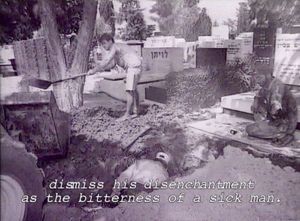
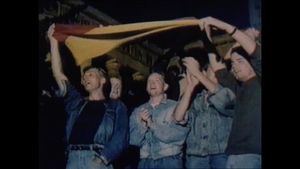
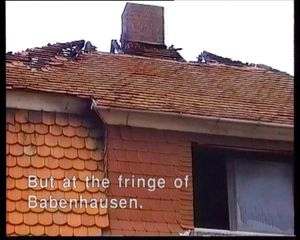
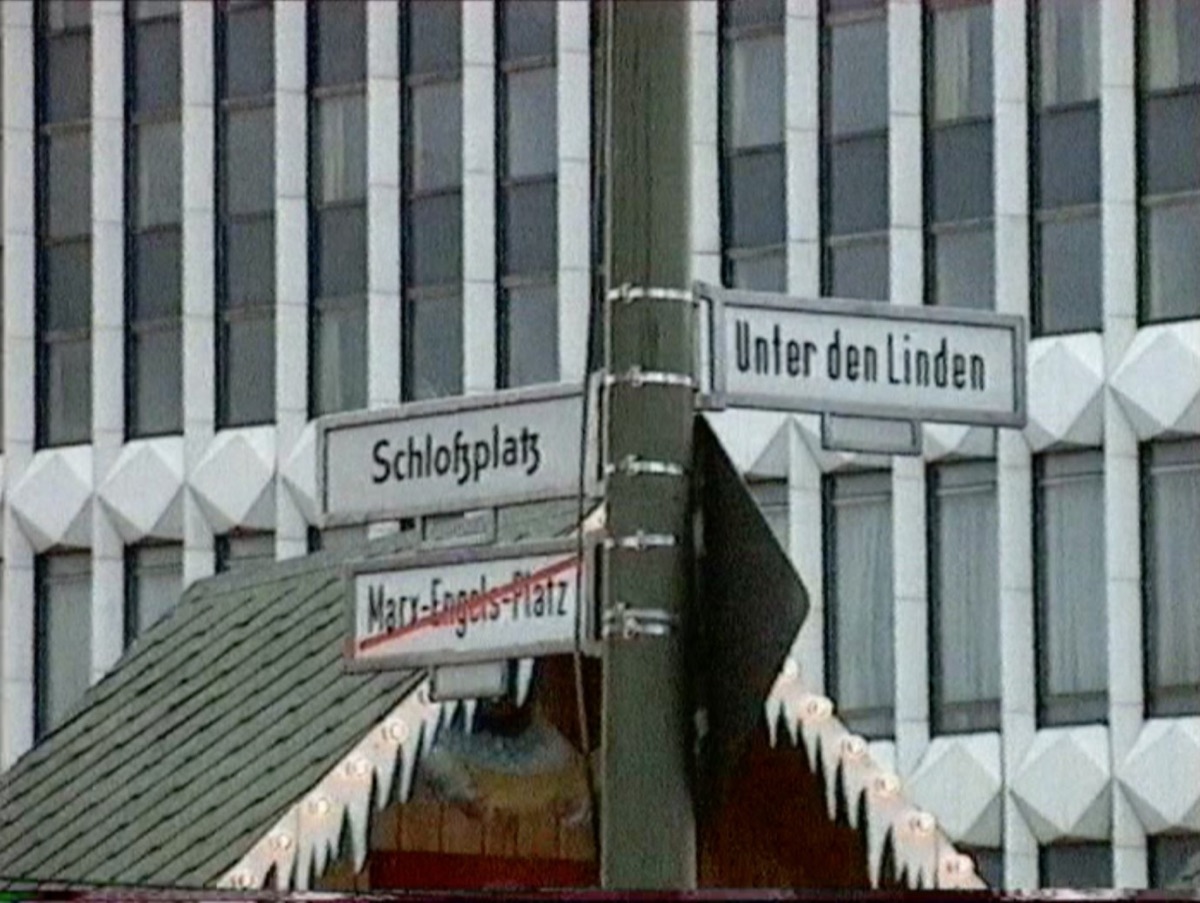
The Empty Center reports on attacks, racist violence and xenophobic politics, but architectural politics, the proclamation of a socialist republic by squatters, residence permits, German colonial history or biographical stories of escape are also loose guidelines. Over a period of eight years, Steyerl observes the area between Potsdamer Platz and the Reichstag in Berlin Mitte, a crystallization site of historical and current conflicts.
© Hito Steyerl
In this vein, the clear climax of the retrospective, installed in megatron scale in the final room, is Steyerl’s 62-minute-long thesis film from 1998 Die leere Mitte (‘The Empty Centre’), an exercise par excellence in memory and the politics of German memory. The cine-essay, drawn from 8 years worth of filming, is cut with images of Potsdamer Platz’s history beginning in the Wilhelmine era to the present day. As Steyerl tells us – through interviews with squatters, archival footage, and contemporary video clips – the area acts as physical synecdoche of Germany’s colonial, racist, and anti-Semitic roots.
Mimi Howard, Another Gaze, 2019-11-11 · read the full text
Ainsi, c’est sur une œuvre fondatrice, Die Leere Mitte (Le Centre vide, 1998), que la déambulation s’achève. Ce long-métrage tourné au centre de Berlin, sur l’ancien couloir de la mort, observe dans ce no man’s land la fabrique de l’Histoire, entre l’édification des bâtiments de multinationales, symboles d’un nouveau pouvoir économique, et les tensions sociales et raciales. La mercantilisation de l’espace public est, avec le retour du passé, un thème récurrent dans ce travail d’une lucidité implacable, qui démontre ici sa pertinence visionnaire. En gros: le pire est toujours certain. Encore faut-il le regarder en face, et le donner à voir.
trans.Thus it is on a foundational work, Die Leere Mitte (The Empty Centre, 1998), that the walk through the show ends. This feature-length film, shot in the centre of Berlin on the former death strip, observes in that no man's land the manufacture of History, between the raising of multinationals' buildings — symbols of a new economic power — and social and racial tensions. The commodification of public space is, together with the return of the past, a recurring theme in this work of implacable lucidity, which demonstrates here its visionary pertinence. In short: the worst is always certain. It still has to be looked in the face, and shown.Anne-Cécile Sanchez, Le Journal des Arts, 20 June 2021 · in fr · read the full text
In DIE LEERE MITTE betont Steyerl, sie wolle eine „Tradition verlorener Prozesse begründen“ und „dem Namenlosen einen Namen geben“. Es handelt sich um eine Notiz von Siegfried Kracauer, die dem unvollständigen und posthum veröffentlichten Werk History. The Last Things before the Last als Epilog dient. Im Original lautet der Satz: „Focus on the ‚genuine‘ hidden in the interstices between dogmatized beliefs of the world, thus establishing a tradition of lost causes; giving names to the hitherto unnamed.“ Tatsächlich ist die Kombination aus „genuine“, „causes“ und „unnamed“ bestechend. Im Film ist „causes“ als „Prozesse“ übersetzt, aber das Wort umfasst eine Gemengelage aus Angelegenheit, Anliegen, Gegenstand und Ursache. Das Erinnern bringt einst lebendige Personen hervor, aktive Personen mit Wahrheiten und Anliegen, die bislang namenlos geblieben sind. Kracauer selbst ist nicht nur Stichwortgeber, auch er wird in DIE LEERE MITTE zu einer lebendigen Person, wenn berichtet wird, dass er als Jude aus Nazi-Deutschland fliehen musste.
trans.In DIE LEERE MITTE Steyerl stresses that she wants to “establish a tradition of lost causes” and to “give a name to the nameless”. This is a note by Siegfried Kracauer that serves as the epilogue to his incomplete, posthumously published History. The Last Things before the Last. In the original the sentence reads: “Focus on the ‘genuine’ hidden in the interstices between dogmatized beliefs of the world, thus establishing a tradition of lost causes; giving names to the hitherto unnamed.” The combination of “genuine”, “causes” and “unnamed” is indeed compelling. In the film “causes” is translated as “Prozesse”, but the word covers a tangle of matter, concern, subject and cause. Remembering brings forth people who were once alive, active people with truths and concerns that have so far remained nameless. Kracauer is not only the one who supplies the cue; he too becomes a living person in DIE LEERE MITTE when it is recounted that he had to flee Nazi Germany as a Jew.Mark Terkessidis, Arsenal Filminstitut / Spector Books, 2020 · in German · read the full text
Keine neue, sondern die historische Mitte Berlins steht im Zentrum eines »Abrisses«, der die titelgebende leere Mitte übervoll erscheinen läßt. Überblendungen zwischen 1990 und 1997 - mit Mauer und dann einem Bauzaun, BesetzerInnen der »Republik Potsdamer Platz« und Baufeldern, Zelten und Containerdörfern, Souvenirständen und Planierraupen, Mauerspechten und Bauarbeitern - bilden den Auftakt. Je mehr sich im Laufe der hochverdichteten Dreiviertelstunde hinzufügt, umso monströser türmen sich die Trümmer und Verluste.
trans.Not a new but the historic centre of Berlin stands at the heart of a “demolition” that makes the empty centre of the title appear overfull. Dissolves between 1990 and 1997 — with the Wall and then a building fence, the occupiers of the “Republic of Potsdamer Platz” and construction sites, tents and container villages, souvenir stalls and bulldozers, wall peckers and building workers — open the film. The more that is added over the course of these highly compressed three quarters of an hour, the more monstrously the rubble and the losses pile up.Jochen Becker, springerin 4/1998, 1998 · in German · read the full text
Die Leere Mitte is een essayistische documentaire met een activistische ondertoon. Steyerl duikt in het verleden van Berlijn als plek waar in 1885 de grenzen van koloniaal Afrika werden getrokken en later de geallieerden slagbomen neerzetten. Xenofobe bouwvakkers die protesteren tegen migrantenarbeiders zet ze tegenover in elkaar geslagen uitwisselingsstudenten uit China.
trans.Die Leere Mitte is an essayistic documentary with an activist undertone. Steyerl dives into the past of Berlin as the place where in 1885 the borders of colonial Africa were drawn and where the Allies later put up their barriers. Xenophobic construction workers protesting against migrant labourers she sets against beaten-up exchange students from China.Edo Dijksterhuis, Het Parool, 18 November 2021 · in nl · read the full text
Credits
Germany 1998, 62 min, 16 mm. Film by Hito Steyerl. Music: Felix Mendelssohn, Friedrich Hollaender. Producer: Su Turhan. Voice-over: Hatice Ayten. Recording: Meike Birck, Hito Steyerl, Boris Schafgans. Texts by Siegfried Kracauer and Friedrich Hollaender. Produced by Hochschule für Fernsehen und Film, München. Protagonists: Dong Yang, Huan Zhu, squatters of Potsdamer Platz, Union of Construction Workers and many others.