Guards
© Hito Steyerl
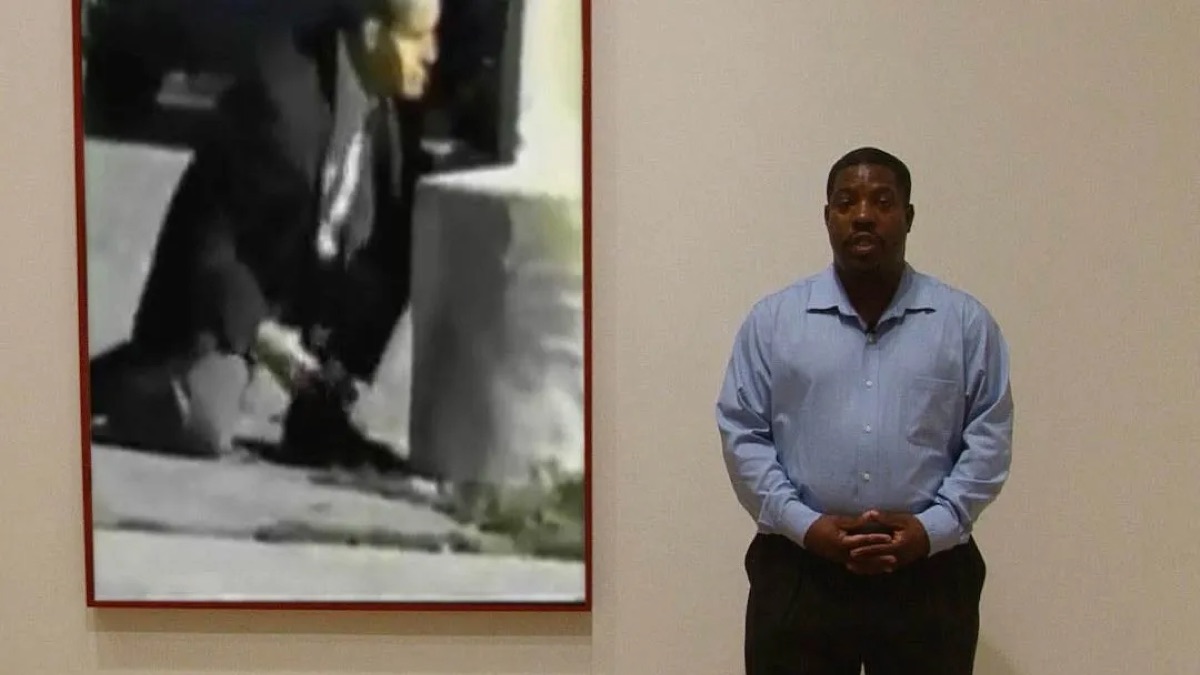
最后一件作品《Guards》更能反映艺术家近年来创作的中心:对美术馆体系的反思。而在故事形式上,这件作品也更近似于她早期的纪录片创作。直立的长方形屏幕上呈现的是芝加哥美术馆警卫的故事:这些警卫原本来自于城市生活的一线,而现在则工作在看似最为安全的文化空间,即美术馆之中,巡逻在画作之间。几位警卫讲述了他们之前巡逻中的经历,回忆着一些案发现场的工作。
trans.The final work, Guards, more fully reflects the centre of the artist's recent practice: a reflection on the museum system. In narrative form, too, this work is closer to her early documentary making. On an upright rectangular screen is the story of guards at the Art Institute of Chicago: these guards originally came from the front line of city life, and now work in what appears to be the safest of cultural spaces — the art museum — patrolling among the paintings. Several of them recount their earlier experiences on patrol, recalling work at various crime scenes.彭祖强 (Peng Zuqiang), Artforum 中文网, 2014 · in zh · read the full text
Guards, 2012, also employs video to investigate ingrained boundaries. Responding to a comment by a University of Chicago professor that museum guards should be armed so as to better protect the institution’s “cultural treasures,” Steyerl recorded museum security staff with military and law-enforcement backgrounds discussing how they might “activate their military experience, their occupational experience... within an art space.” She then projected this HD footage onto a column-shaped structure that mimicked the presence of an officer at his post. In the piece, we watch two guards recount experiences of violence while posing in front of artworks (composited with obvious special effects) and then as they pursue an absent “suspect” through the galleries. Later in the video, several paintings metamorphose into surveillance footage of “real” crime or compressed portraits of camouflage-clad figures, thus visualizing a cross-circuit between modernist abstraction and militarized formats that the artist leaves productively unresolved.
Solveig Nelson, Artforum, 2013-02 · read the full text
In the Logan Center basement, Hito Steyerl’s video work “Guards” features interviews with art museum security guards discussing the imagined art criminals they would “neutralize” with their military and police training. The interpenetration of real-world violence with artworks and art institutions is a curious through-line to a show about the Obama era.
Morley Musick, Hyde Park Herald, 30 July 2026 · read the full text
Guards begins on a blackscreen that shows only the piece’s title accompanied by the sound of slow, measured footsteps. The result of this opening is a playful confusion as the gallery visitor cannot be sure whether these unseen, roaming feet come from the speakers of the video setup or from the very gallery space she finds herself in. Her head may turn to make sure that nobody is approaching her from behind. Thus, as the video temporarily blurs the boundary between the gallery visitor’s own surroundings and the representational space of the video, her spatial awareness heightens and she is bound to think the video’s subject matter through her own embodied relation to the gallery space.
Toni Pape, Critical Studies in Television 14(1), March 2019 · read the full text
Credits
Single-channel 9:16 HD video, 19:30 min, 2012. Protagonists: Ron Hicks, Martin Whitfield, Corey Burage, Modesto Correa, Darrell Evans. Director of photography: Kevan Jenson. Dolly grip: Jordan Campagna. Produced by Lisa Dorin, Ben Thorp Brown, Tracy Parker. Production manager: Tracy Parker. Assistant director: Ben Thorp Brown, Alwin Franke (Berlin). Editing: Cristovão dos Reis, assisted by Maria Frycz. Postproduction and compositing: Christoph Manz. Original installation developed by Diogo Passarinho and Yulia Startsev for Studio Miessen. Produced by the Art Institute of Chicago. Security: Hito Steyerl.