How Not to Be Seen
© Hito Steyerl
Full work · 15:52 · Artforum
Pressing play loads the video from Vimeo.
은 마치 어릴 적 본 교육 비디오 영상들이 생각나게 하는 작품이다. 5장으로 구성된 게릴라 매뉴얼의 형식을 빌려 디지털 기반의 감시 사회 속에서 우리가 가시성의 장에서 '안 보일 수 있는 방법'을 다섯 가지로 설명한다.
trans.How Not to Be Seen: A Fucking Didactic Educational .MOV File is a work that calls to mind the educational videos one saw as a child. Borrowing the form of a guerrilla manual in five lessons, it explains five ways in which we might 'become invisible' within the field of visibility, inside a digitally based surveillance society.한승하 (Han Seung-ha), ArtInsight, 2022-09-01 · in ko · read the full text
Punctuated by blocky inter-titles (dictated by a text-to-speech avatar), the five lessons in HOW NOT TO BE SEEN (“How to Make Something Invisible for a Camera,” “How to be Invisible in Plain Sight,” “How to Become Invisible by Becoming a Picture,” “How to be Invisible by Disappearing,” and “How to Become Invisible by Merging into a World Made of Pictures”) duly reflect the work’s heavy-handed title. As art historian David Joselit has argued (via the work of Seth Price), and as media theorist Alexander Galloway has established in his writing on protocols, digital formats and the specific transitive actions they offer enable access to information at the same time as they reinforce structures of control. Accordingly, each of Steyerl’s five sections proffers a reductive inventory of evasion tactics for those wary of Big Data (the spectrum of ways “to disappear” evoked above). While the first three sections of the video establish more individually-focused protocols, the last two expand Steyerl’s exercise to an ecological and social level.
Kaegan Sparks, Momus, 2015-05-12 · read the full text
Starting with the basic, pressing question of how to evade surveillance in a world read through moving images, Hito Steyerl’s influential video picks apart what it means to disappear. If surveillance feels grossly invasive, how do we feel about the invisibility afforded to the vastly wealthy? What about the invisibility bestowed by a burqa, systemic bigotry, or extraordinary rendition? Shot on an abandoned satellite “resolution target” in the California desert, How Not to Be Seen is conceptually intense, but retains the daffiness of the Monty Python sketch that inspired it. An artist and theorist both, Steyerl beguiles us into contemplating uncomfortable questions with wit and charm.
Hettie Judah, The Guardian, 17 September 2019 · read the full text
What do ‘living in a gated community’, ‘surfing the dark web’ and ‘being a disappeared person’ have in common? These examples of ‘how not to be seen’, from Hito Steyerl’s 14-minute video by the same name, cast invisibility variously as privilege, resistance strategy and extra-legal punishment in an epoch of data surveillance, social media and drone warfare. Coinciding with related interrogations of (in)visibility by such artists as Zach Blas, James Bridle and Sondra Perry, as well as in Steyerl’s own writings, this absurdist how(-not)-to – a parody of wartime public information films – asks still-pressing questions about visibility and violence, and the potential for defiance and play in the face of data capture.
Cassie Packard, frieze, 24 October 2025 · read the full text
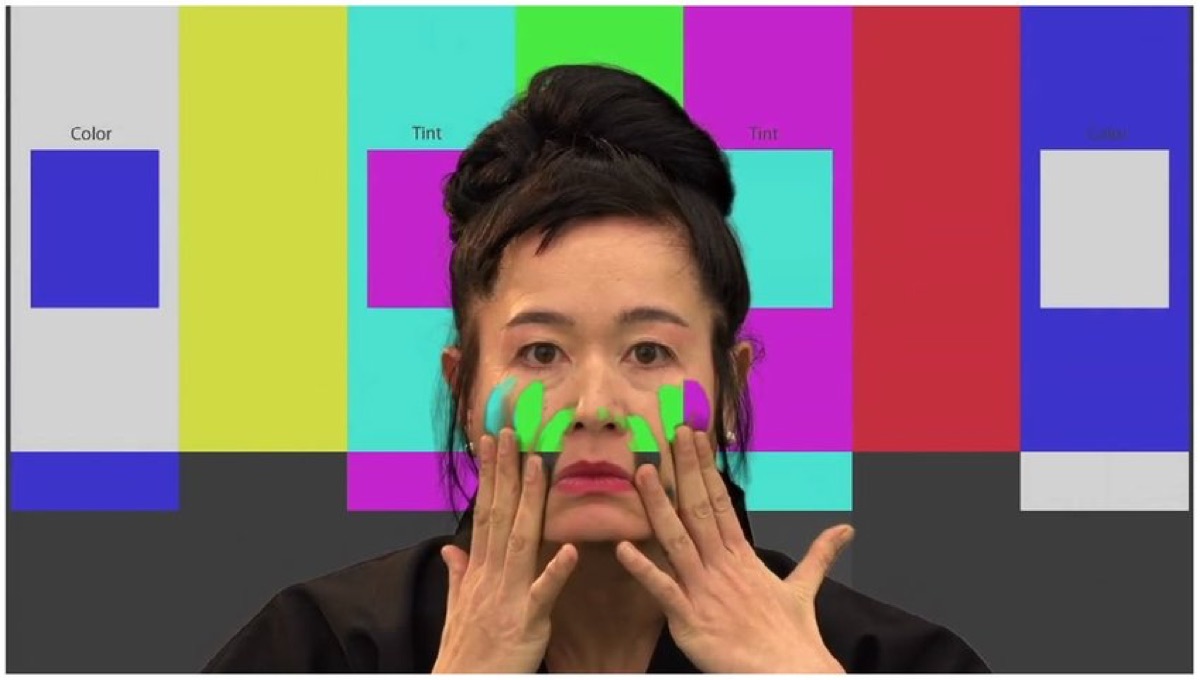
Partly shot on location at one of these disused targets, How Not to be Seen begins as an instructional video informing viewers how to remain invisible in an age of image proliferation. Various possible strategies are outlined. One suggestion is to camouflage oneself (to demonstrate, Steyerl smears green paint on her face and is chroma-keyed into invisibility). Another suggested tactic is to be smaller than the size of a pixel. For this demonstration, several people appear on camera wearing pixel-like boxes on their heads. Wearing a box on one's head may seem unpleasant, but in Steyerl's video it seems quite fun, imbued with some of the techno-human spirit of Bauhaus theater costumes. After these tactics are outlined, the film crew making this educational video also disappears. In their absence, happy low-resolution pixels take over the production. Digital rendering ghosts dance in the desert landscape as The Three Degrees' "When Will I See You Again" plays on the soundtrack. Silliness ensues.
Michael Connor, Rhizome, 31 May 2013 · read the full text
Bu taktikler videodaki sırasıyla, kamera için görünmez bir şey yapmak, düz bir bakışa göre görünmez olmak, imgenin kendisi olarak görünmez olmak, kaybolarak görünmez olmak ve imgelerden oluşan bir dünyayla birleşerek görünmez olmaktır. Bu doğrultuda ilk üç taktikte video sanatçısı, ekranın önünde dış ses tarafından verilen talimatları yerine getirir. Buradaki taktik, yeşil ekran kullanarak var olan teknolojiyi şaşırtmaktır; sanatçı bir noktada kendini de yeşil boyayla kaplayarak kamufle olur. Başka bir taktik ise imgenin kendisi olarak görünmez olmaktır; dış ses bunun için piksel boyutundan daha küçük hâle gelmeyi önerir. İlk başta imkânsız gözüken bu talimat, kamerada piksel benzeri siyah veya beyaz kutular giyen üç kişi tarafından yerine getirilir. Üç kişi yavaşça dans ederek, imgenin sabitlendiği alandaki final pozisyonlarını alır. Siyah ve beyaz piksellenmenin hedefi, hava görünümündeki çözünürlüğü düşük bir imgenin bir arka planı olarak kalmak ve böylece görünmez olmaktır.
trans.These tactics are, in the order they appear in the video: making something invisible to the camera; becoming invisible to a straight-on gaze; becoming invisible as the image itself; becoming invisible by disappearing; and becoming invisible by merging with a world made of images. In the first three tactics the video artist carries out instructions given by an off-screen voice in front of the screen. The tactic here is to confuse existing technology by using a green screen; at one point the artist camouflages herself by covering her own body in green paint. Another tactic is to become invisible as the image itself; for this the voice-over proposes becoming smaller than the size of a pixel. This instruction, impossible at first sight, is carried out by three people wearing pixel-like black or white boxes on camera. Dancing slowly, the three take up their final positions in the area where the image is fixed. The aim of the black-and-white pixellation is to remain as the background of a low-resolution aerial image and so to become invisible.Eda Yeyman, Manifold, 27 April 2020 · in tr · read the full text
Credits
2013, HD video file, single screen, 14 min. Director of photography, Berlin: Christoph Manz. Director of photography, Los Angeles: Kevan Jenson. 2nd unit: Leon Kahane. AD: Esme Buden, Alwin Franke. Postproduction: Christoph Manz, Leon Kahane, Alwin Franke. Make-up and costume design: Lea Søvsø. Original blackbox developed by Diogo Passarinho and Yulia Startsev for Studio Miessen. Choreography and performance: Arthur Stäldi. Producer: Kevan Jenson. Dolly grip, Los Angeles: Tony Rudenko. Educational dummy: Hito Steyerl. Commissioned by Massimiliano Gioni, Venice Biennale. Supported by the International Production Fund (IPF). Thanks to Brian Kuan Wood, Meggie Schneider, Laura Poitras, Diana McCarty, Christopher Kulendran Thomas, Anton Vidokle.