In Free Fall
Synopsis
In the course of the cascading images of In Free Fall, the filmmaker herself appears; reading her text about the changeability of technical things. While speaking, she makes an error. Instead of saying that things continue to live, she says that they continue to love. The montage grasps this slip of the tongue (also a free fall), and turns it into a glitch. Reiteration of the error, which is celebrated like a hip hop sample, becomes just as programmatic as its content, considering polymorphous life and love as one – with devotion and unpredictable attraction. In line with Sergej Tretjakov´s concept of a "biography of an object" from 1929, the film spins out a technological history full of allure and recursion.
© Hito Steyerl
In Free Fall draws on a rich tradition of politicised, avant-garde film essays – Chris Marker and Jean-Luc Godard are obvious reference points. But a particularly illuminating comparison, perhaps, is with Harun Farocki’s Inextinguishable Fire (1968). That film presented a critique of the Vietnam War as told through the interrogation of a commodity – in this case napalm – yet as Farocki explains in the opening scene, he explicitly doubts the power of the conventional film image to convey his message. Steyerl takes the opposite tack, cramming her film full of familiar, repeated images and motifs. The result is mesmerising – and I use that word advisedly. In Free Fall captivates the viewer, but it also dazzles.
Daniel Trilling, Sight & Sound (BFI), 2011-11-26 · read the full text
It is the moment upon which Hito Steyerl’s In Free Fall (2010) hangs suspended. The last sentence of the preceding paragraph sounds like airplane armchair metaphysics, when actually, it is clearly matter that is at stake in Steyerl’s film, or to be more precise, the materiality of images, images as things. You can see that in a very literal way in the montage that serves as the film’s opening and binds together its three parts as a refrain. Against an apocalyptic sky, a jetliner breaks up in mid-air, and people get sucked out the back. The plane smashes into the ground wing first. Chunks of burning engine fall to the palm-lined beach. Survivors emerge from the debris, crying children in their arms. YouTube fragments become blurred geometries in the darkroom clarity of HD. This is a collective material we all know in the moment before we see it, cut sequences subconsciously memorized, screaming to be reused.
David Riff, transversal / eipcp, February 2011 · read the full text
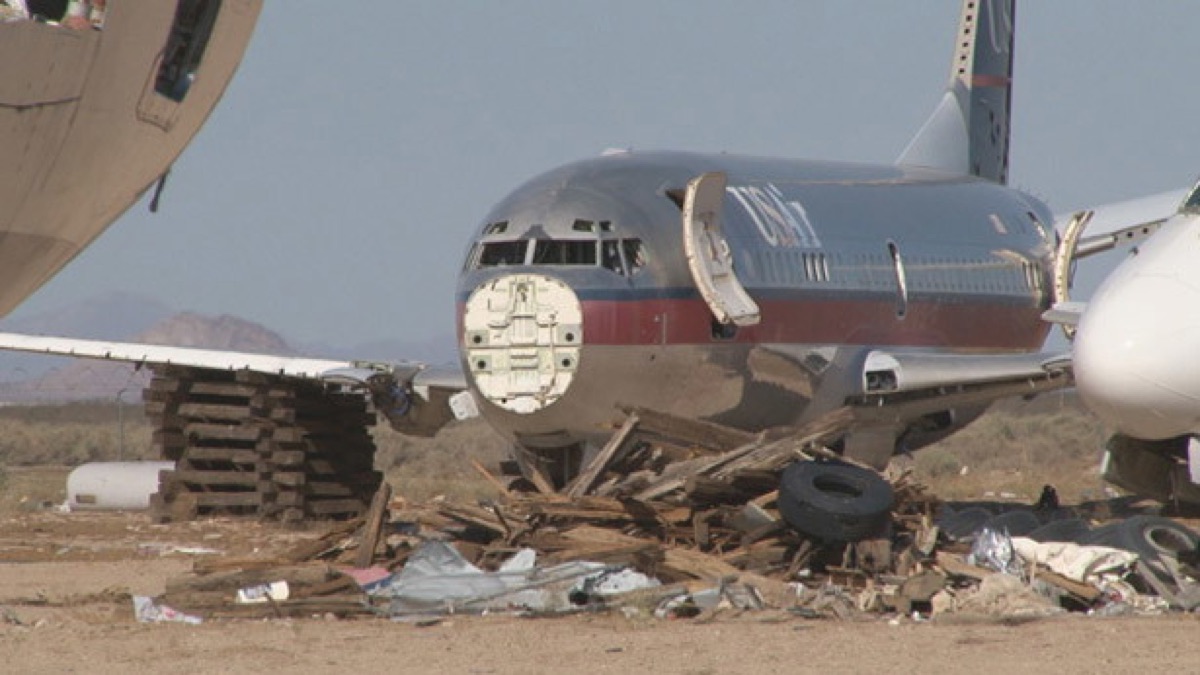
Taking as its starting point the Russian Constructivist playwright and “factographer” Sergei Tretyakov’s 1929 essay, “Biography of the Object,” In Free Fall is a “recycled biography” of a Boeing 4X-JYI jet, following its material history from Trans World Airlines to the Israeli Air Force to a Southern California scrapyard to a Hollywood backlot—where it’s used as a film prop in movies like Speed—and then finally to a factory, where the jet’s metal is recycled into DVDs. The cinematic image of the jet is then burned onto a Chinese bootleg disc made from the scrapped jet, and this disc is, in a way, just as much an image of the jet as is the Hollywood blockbuster. The 32-minute video’s three episodes—“before the crash,” “crash,” and “after the crash”—allude, perhaps, to a financial crash or free fall. Indeed, lurking in the background of the whole video is a kind of violence, whether Israeli state-sanctioned violence or spectacular, cinematic violence.
Alec Mapes-Frances, The College Hill Independent, 18 September 2015 · read the full text
By contrast, After the Crash blends documentary tropes with intense visual imagery and appropriated footage into a powerful piece that illustrates a disquieting vision of a possible life cycle for recycled airplane parts, as well as the current global economic downturn. The film begins with scenes from an unidentified Asian airline’s safety-service announcement and various depictions of airplane crashes. Original portions that Steyerl shot in an airplane junkyard in the California desert follow, in which she interviews a man who runs the business and describes how lucrative it is to sell parts to Chinese buyers. Next, images of the airplanes being disassembled are interwoven with portions of appropriated documentary footage of aluminum being made into CDs, all set to an intense mix of pop music.
Ana Finel Honigman, Artforum (Critics' Picks), September–October 2009 · read the full text
Opening with an image of a Boeing airliner falling to the ground, Hito Steyerl’s video In Free Fall (2010) is action-packed, supercharged, and visually enthralling. Steyerl’s work presents re-edited footage from Hollywood disaster movies portraying an airliner about to crash over a nondescript suburban town. In this fast-paced montage a stunned pilot stares at the message ‘system failure’ flashing in the cockpit instrument panel while emergency oxygen masks drop down over the passengers’ heads; the fuselage splits apart and objects inside the cabin start whirling around. This scene is, according to Steyerl, a metaphor for the mayhem generated by the 2008 banking crisis, which saw global financial institutions previously thought to be rock solid collapse in the space of few days. In In Free Fall, contemporary capitalism emerges as a precarious world, rife with destruction.
Paolo Magagnoli, Third Text 27(6), 723–734, 2013 · read the full text
Credits
Director and script: Hito Steyerl. Camera: Kevan Jenson, Christoph Manz. Editing: Cristóvão dos Reis. Sound design: Cristóvão dos Reis. Dramaturgical advice: Boris Buden, Imri Kahn. Painting: Kevan Jenson. Postproduction: Christoph Manz. Cast: Mike Potter, Imri Kahn, Hito Steyerl, Kevan Jenson. Choreography: Arthur Stäldi. Commissioned by Chisenhale Gallery, Collective Gallery and Picture This. Assistance: Yeliz Palak, Ariel Reichmann. Supported by Visualize This Inc., Scottish Arts Council, Arts Council England, Henie Onstad Art Center Oslo, n.b.k. Berlin, Taipei Biennial.