Leak
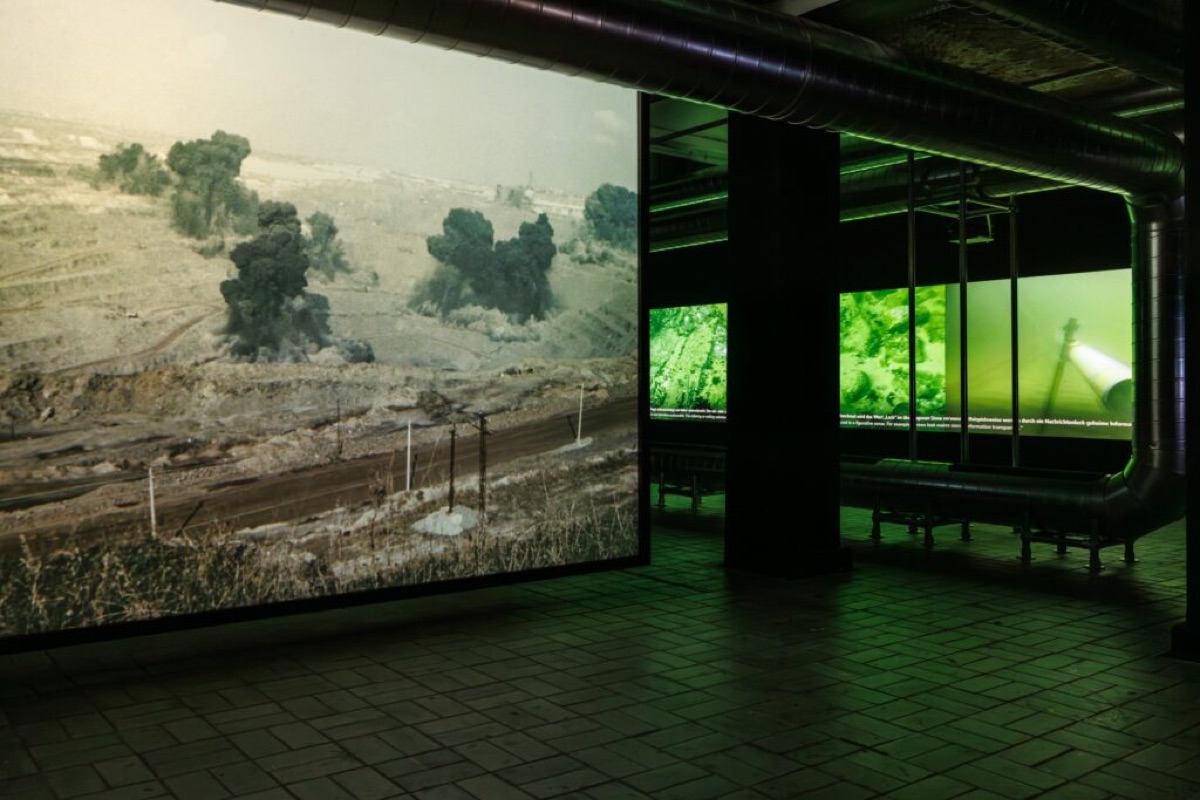
In Hito Steyerls „Leak“ hingegen steigt man in die Erde hinab. Die Arbeit wurde schon in der vergangenen Ausgabe der Kyiv Biennale in Warschau präsentiert und ist jetzt in den KW so perfekt installiert, dass man sich zwischen den als Sitzbänken platzierten Metallröhren wie im dunklen Bauch der Erde fühlt. „Leak“ beschäftigt sich mit der Entwicklung des Gaspipelinesystems zwischen Sibirien und Westdeutschland, die bis ins Jahr 1900 zurückreicht. Dafür verwebt Hito Steyerl Archivmaterial mit KI-generierten Bildern.
trans.In Hito Steyerl's Leak, by contrast, one descends into the earth. The work was already shown in the last edition of the Kyiv Biennale in Warsaw, and is now installed so perfectly in the KW that, among the metal pipes placed as benches, one feels as if in the dark belly of the earth. Leak deals with the development of the gas pipeline system between Siberia and West Germany, which reaches back to 1900. For it, Hito Steyerl weaves archival material together with AI-generated images.Laura Helena Wurth, Frankfurter Allgemeine Sonntagszeitung, Nr. 24, 2026-06-14 · in German · read the full text
Einen großen Raum füllt Hito Steyerl mit ihrer Installation aus Röhren, Bildschirmen, Texttafeln, unter dem Titel Leak hat sie zusammen mit dem ukrainischen Filmemacher Oleksiy Radynski und dem Kulturforscher Philipp Goll eine historische Spurensuche unternommen: Es wird die lange Vorgeschichte der Nord-Stream-Pipelines erzählt, denn schon in den 1970er-Jahren wurde sowjetisches Gas aus Sibirien nach Westdeutschland transportiert. Teil dieser Installation ist Radynskis Film, der mit wieder aufgetauchtem Filmmaterial aus den 1980er-Jahren den sowjetischen Kolonialismus in Sibirien veranschaulicht, die Vertreibung indigener Gruppen von ihrem Land, durch das ungestört das Gas fließen sollte. Auf fünf großen Screens gibt es dazu die von Steyerl mit subtilem Humor ausgewählten und gegeneinandergeschnittenen Unterwasserbilder von Nord Stream und Szenen jener "Kulturpipeline", die Geschäfte zwischen Deutschland und Russland gut schmieren sollte: Kulturprogramme und Ausstellungen, die etwa von der Deutschen Bank mitfinanziert wurden.
trans.Hito Steyerl fills a large room with her installation of pipes, screens and text panels; under the title Leak she has undertaken, together with the Ukrainian filmmaker Oleksiy Radynski and the cultural researcher Philipp Goll, a historical search for traces: the long prehistory of the Nord Stream pipelines is told, for Soviet gas was already being transported from Siberia to West Germany in the 1970s. Part of the installation is Radynski's film, which uses re-surfaced footage from the 1980s to illustrate Soviet colonialism in Siberia, the expulsion of indigenous groups from their land so that the gas could flow through it undisturbed. On five large screens there are, alongside this, the underwater images of Nord Stream that Steyerl has selected and intercut with subtle humour against scenes of that “cultural pipeline” meant to grease the business dealings between Germany and Russia: cultural programmes and exhibitions co-financed, for instance, by Deutsche Bank.Tobias Timm, Die Zeit, 26 October 2025 · in German · read the full text
Everywhere you look, a moving picture is projected or playing on a screen and the infamous Nord Stream pipeline, also referred to as the “cultural pipeline” by Steyerl, is examined four years after its destruction. Previously shown in Leipzig two years ago, the body of work creates an interesting assemblage of perspectives, interviewing pipeline workers who worked in East Germany at the time and using generative AI to fill the gaps.
Mia Butter, Berlin Art Link, 2026-07-10 · read the full text
Третя частина експозиції — робота «Витік» Хіто Штайерл — розміщені на великій стіні екрани, зображення на яких рухаються ними, ніби речовина у трубах. Головна тема зображеного тут — формування дискурсу навколо цього трубопроводу як акції дружби між німецьким та (радянським) російськими народами. Основним інструментом для конструювання є культура. Так, приватні компанії як Mannesnamm AG і Deutsche Bank, Ruhrgas AG співпрацювали з Міністерством культури СРСР, щоби організувати виставки російського (радянського) мистецтва і показу його у містах Німеччини, німецьке мистецтво експонували в Радянському Союзі. Ці культурні проєкти отримали назву «культурного трубопроводу»(sic!), який зближував дві культури й створював додану вартість до газових угод.
trans.The third part of the exposition — Leak by Hito Steyerl — consists of screens placed on a large wall displaying images that move like liquid inside pipes. The main theme is nurturing the discourse around this pipeline as a manifestation of friendship between German and (Soviet) Russian people. Culture is the basic tool of its construction. For instance, private companies like Mannesnamm AG and Deutsche Bank, as well as Ruhrgas AG, cooperated with the USSR Ministry of Culture to arrange exhibitions of Russian (Soviet) art and display it in German cities while German art was shown in the Soviet Union. Those cultural projects were dubbed a “cultural pipeline” (sic!), bringing the two cultures closer and adding value to gas supply contracts.Марія Ткаченко (Maria Tkachenko), Artslooker, 30 September 2024 · in uk · read the full text
Ще один невивчений урок — балада про газову залежність в інсталяції «Витік» Гіто Штеєрл, що супроводжувалася дослідженням Філіппа Ґолля «Хронологія: Кінець газопроводу» про торгівлю газом між Росією та Німеччиною. Затемнена кімната, заповнена хитросплетіннями труб, освітлювалася п’ятьма мультиекранами, на яких розгорталася панорама російської енергетичної експансії Німеччини — історії, що тягнеться ще від 19 століття і формує тривалу логіку взаємної залежності. Ішлося не лише про технічну чи політичну еволюцію домовленостей. Відеонаратив оприявнював й іншу, менш видиму мережу культурних обмінів, партнерств і символічних жестів, які супроводжували економічні угоди та створювали атмосферу довіри. Так постало те, що куратори назвали «культурним газопроводом» — каналом, через який енергетична співпраця легітимізувалася мовою мистецтва.
trans.Another lesson not learned is a ballad of gas dependence in the installation, The Leak, by Hito Steyerl, accompanied by Philipp Goll’s research of gas trading between Russia and Germany, Chronology. The End of the Pipeline. A dark room with a cobweb of pipes was lit up by five multi-screens displaying the panorama of Russia’s energy expansion in Germany—a story dating back to the 19th century and shaping a long-standing logic of interdependence. It was not solely about the technical or political evolution of arrangements. The video narrative revealed another, less visible network of cultural exchanges, partnerships, and token gestures associated with economic agreements that promote a climate of trust. Thus emerged something which curators named the “cultural pipeline”—a channel enabling the energy cooperation to be legalised through the language of art.Аміна Ахмед і Анфіса Дорошенко (Amina Ahmed and Anfisa Doroshenko), Artslooker, 9 April 2026 · in uk · read the full text
Hito Steyerl and Philipp Goll do this with their video installation Trassniki, 2026, on the second floor. The piece features interviews with the East German laborers, or trassniki, who worked on the Druzhba, a land-based conduit built between 1976 and 1979 and the “Gas Pipeline,” constructed between 1982 and 1993, that ran through vast expanses of Russia. A labyrinthine arrangement of industrial gas conduits, thick as tree trunks, function as visitor seating. They also operate as a framework, both physical and metaphorical, for several other videos, including Steyerl, Goll, and Oleksiy Radynski’s THE LEAK, 2024. The work highlights the economics linking the Soviet Union and West Germany via fossil fuels in the 1980s, which produced a “cultural pipeline”—Russian state-run art institutions would collaborate with German corporations to stage blockbuster exhibitions and other major art events. Steyerl critiques this facade of public diplomacy, which was used to legitimize shady business dealings between the countries.
Jörg Heiser, Artforum, 2026-10-01 · read the full text
Credits
Leak, 2024. Pipeline structure, 5-channel video, 21 min, sound. Direction: Hito Steyerl. Research: Philipp Goll. Idea and visual research: Oleksiy Radynski. Postproduction: Christoph Manz. Installation work: Manuel Reinartz. Production: Lyuba Knorozok for Museum der bildenden Künste Leipzig. — Press images: Hito Steyerl, Leak, video still, 2024, © VG Bild-Kunst Bonn 2024, courtesy Blue Eye Robotics; installation views © VG Bild-Kunst Bonn 2024, photo Alexander Schmidt / PUNCTUM.