The Island
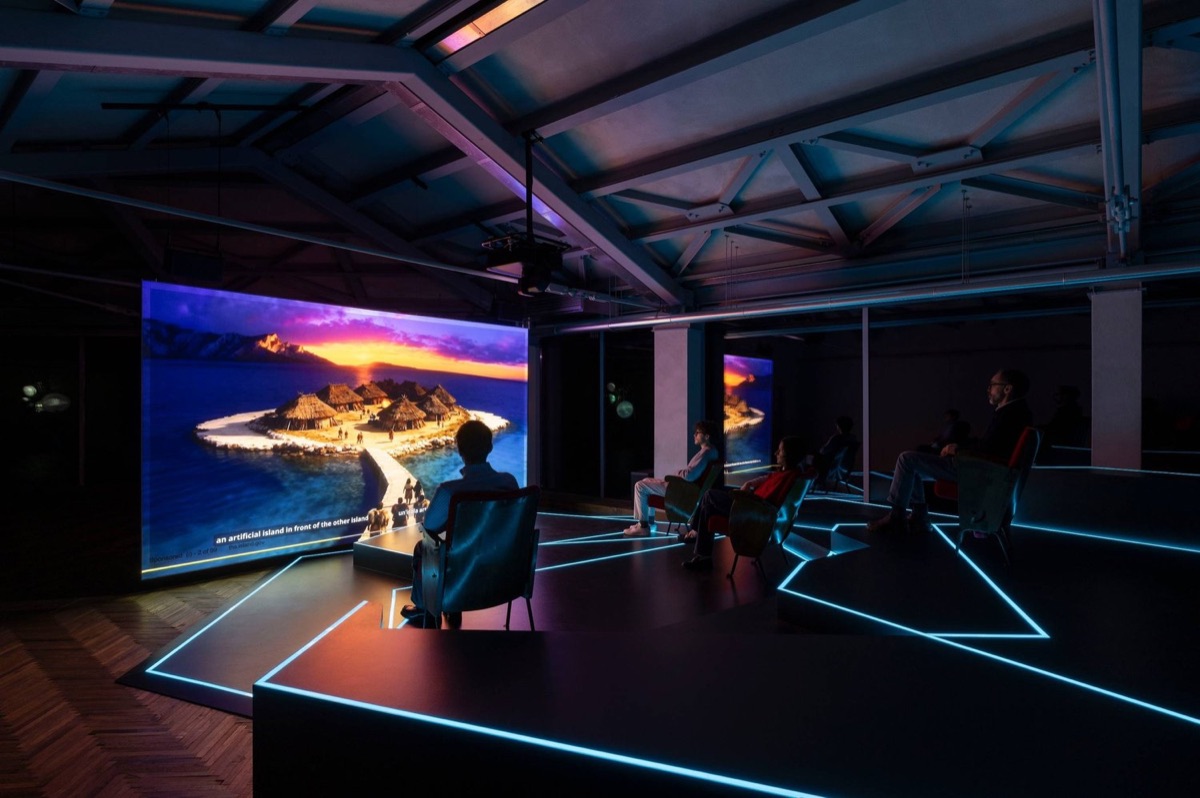
Interview · 3:30 · Fondazione Prada
Pressing play loads the video from YouTube.
Here, the submerged island becomes a figure for a broader process, currently driven by a tsunami of artificial images that are low in resolution, high in circulation, and structurally disposable. Designed to evade time while nevertheless saturating the present, these images form the background against which Steyerl’s work persistently returns, deconstructing the nexus between digital technologies, the intensification of algorithmic power, and the progressive dispossession of individual and collective agency. What emerges is an oscillatory, critical assemblage — fluctuating between diagnostic clarity and speculative escape routes from the necrosis of simulation — aimed at challenging the persistent condition of aesthetic fatigue.
Piermario De Angelis, Flash Art, 2026-05-04 · read the full text
The Island si presenta come un occhio d’uragano, una capsula temporale, un luogo dove i tempi profondi della Terra si sovrappongono alle urgenze del presente. Qui la fantascienza non è un rifugio, ma una lente d’ingrandimento e, attraverso di essa, Steyerl osserva un oggi segnato da nuove forme di autoritarismo, sistemi di controllo sempre più invisibili e una comunicazione così frammentata da rendere fragile perfino la possibilità di condividere la stessa realtà.
trans.The Island presents itself as the eye of a hurricane, a time capsule, a place where the deep time of the Earth overlaps with the urgencies of the present. Here science fiction is not a refuge but a magnifying lens, and through it Steyerl observes a today marked by new forms of authoritarianism, ever more invisible systems of control, and a communication so fragmented that it makes even the possibility of sharing the same reality fragile.Salvatore Cristofaro, exibart, 2025-12-11 · in Italian · read the full text
La sua riflessione, anche attraverso le bolle presenti nell’installazione, che richiamano le bolle di filtraggio generate dagli algoritmi, è dedicata principalmente al ruolo sempre più pericoloso della tecnologia digitale applicata a vari ambiti, per esempio a quello bellico, che credevamo lontano dal nostro mondo e che nell’ultimo periodo, invece, ci coinvolge molto più di quanto non si possa credere.
trans.Her reflection, including through the bubbles present in the installation, which recall the filter bubbles generated by algorithms, is dedicated chiefly to the ever more dangerous role of digital technology applied to various fields — for example the military one, which we believed far from our world and which lately, instead, involves us far more than one might think.Angela Madesani, Artribune, 2025-12-18 · in Italian · read the full text
Credits
With Darko Suvin, and Mark Waschke as Flash. Klapa Ivo Lozica (Anamaria Milina, Romano Šestanović, Petar Šegedin, Roko Radovan, Nedo Lipanović, Marin Milina, Josip Ivančević, Ante Nobilo); Mate Parica (and Marta Kalebota); Tommaso Calarco. Osti fishermen: Petar Barčić, Roko Barčić, Ante Nobilo. Technical assistance and underwater drone: Mario Mu. Drone camera: Ante Nobilo. Local producer and cooking: Boris Buden. Costumes: Lea Søvsø. Excerpts from the public-domain film Mars Attacks the World (1936). Dramaturgy: Maximilian Schmoetzer. Postproduction: ERRATA and Christoph Manz. Quantum effects: Volker Möllenhoff. Unity renderings: Lucas Gutierrez. Intro Bioluminescence — music and arrangement: Roko Radovan; producers: Petar Šegedin, Ante Nobilo, Roko Radovan. Installation design: Manuel Reinartz.