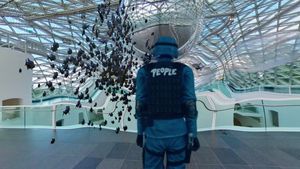
Factory of the Sun
© Hito Steyerl
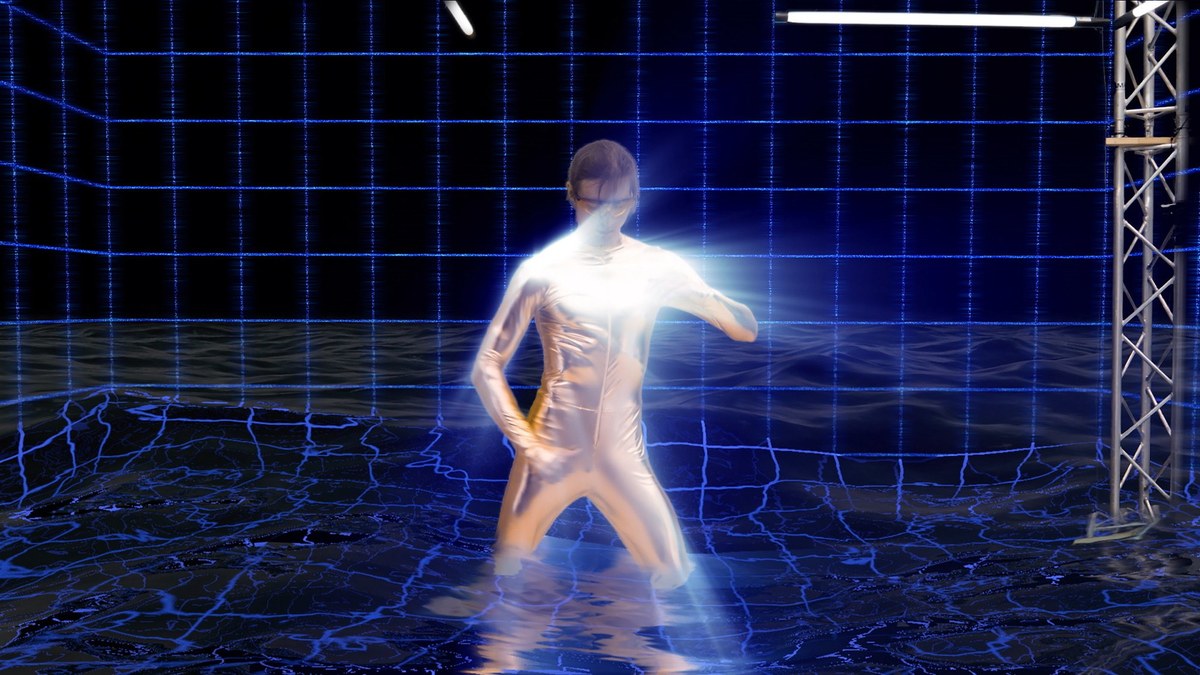
〈태양의 공장〉에서도 춤이 소재로 등장하는데 이번에는 게임과 애니메이션 제작을 위해 모션캡처 슈트를 입은 영상 스튜디오 노동자들의 댄스 타임이다. 하지만 흥겨울 것이라는 예상은 보기 좋게 빗나간다. 슈트에 달린 센서가 노동자들의 동작을 감지해 컴퓨터로 캡처하고 데이터화하는 장면이 상영되는데, 강요된 안무를 ‘구사’하는 이들의 몸짓은 즐거운 감정에서 비롯되어야 하는 춤이 데이터 기반의 가상 세계를 위해 일종의 노동 착취로 환원되는 현상을 은유한다.
trans.Dance appears as a subject in Factory of the Sun too, but this time it is the dance-time of video-studio workers wearing motion-capture suits for the production of games and animation. Any expectation of merriment is neatly confounded. As the sensors on the suits register the workers' movements and capture and datafy them for the computer, the gestures of those 'performing' a compelled choreography become a metaphor for how dance — which ought to arise from joy — is reduced to a kind of labour exploitation for the sake of a data-based virtual world.서민경 (Seo Min-kyung), Design+, 2022 · in ko · read the full text
展場是一個由藍光網格所構成的黑盒空間,彷彿夢境般的奇妙維度,觀賞者必須躺在大螢幕前的躺椅上,才好完全「沉浸」於這片虛幻的蒙太奇;螢幕中長達23分鐘的影片,講述的是一個超現實的故事,描繪一群工人被強迫運動以產生人工陽光,內容穿插著紀錄片、網路遊戲、各式假新聞、無人機監控畫面等現實與虛構交織的畫面。
trans.The exhibition space is a black box formed of a grid of blue light, a strange dimension like a dream; visitors must lie on the deck chairs in front of the large screen in order fully to be 'immersed' in this illusory montage. The 23-minute film on the screen tells a surreal story, depicting a group of workers forced to move in order to generate artificial sunlight, interspersed with documentary, online games, assorted fake news and drone surveillance footage — images in which reality and fiction are interwoven.趙凱喬 (Zhao Kai-chiao), 自由時報 Liberty Times, 2022-09-24 · in zh-TW · read the full text
An assortment of beach chairs faces a slanted screen. Friends have admitted to falling asleep as they recline on those deck chairs, being soothed by a faux-news program, or perhaps a Balearic beat pulsing in the background. The end and beginning of the film are hardly relevant, as the work is realized as a looped montage: a video game tutorial threaded with breaking news segments, YouTube dance clips, animated avatars of ghost protesters in the near future, actual footage from student demonstrations worldwide, and bobbing renderings of Joseph Stalin’s head used as target practice. The layers, both theoretically, historically, and cinematically dense, are frightening but uncannily familiar. This is a twisted contemporary visual reality that we’ve been forced to accept—a 24-hour barrage of information, a thrust of barely comprehensible data that passes through our body unnoticed like rays of weird sunshine.
Justin Lubliner, this is tomorrow, 2016 · read the full text
Hito Steyerl’s landmark video installation Factory of the Sun (2015) explores how the endless circulation of images in contemporary media influences our reality. On screen, the distinctions between truth and fiction dissolve in a montage of YouTube dance videos, drone surveillance footage, video games, fictitious news segments and documentation of student uprisings. This alternate reality extends beyond the screen, immersing viewers in a glowing grid that connects the physical gallery to the virtual world of the film.
Duncan Bass, Singapore Art Museum, 2023 · read the full text
Hvorfor solstolene? Fordi det er skærmens lys vi soler os i og fordi «solfabrikken» først og fremmest er en metafor for den teknologiske sols triumf over den virkelige sol i et accelereret kapitalistisk slutspil om at få lys, kapital og information til at smelte sammen i en absolut magtform. Factory of the Sun kan bedst beskrives som et stykke meta-dokumentar om kapitalismens final fantasy. Stilistisk set er der tale om en dopamin-pumpet blanding af computerspil, musikvideo, infomercial og dokumentarfilm.
trans.Why the sun chairs? Because we bask and sun ourselves in the light from the screen, and because the “factory of the sun” is more than anything a metaphor for the technological sun’s triumph over the real sun in an accelerated capitalist endgame that aims at making light, capital and information merge to become an absolute form of power. Factory of the Sun is best described as a meta-documentary about the ultimate fantasy of capitalism. Stylistically this is a dopamine-heavy mixture of a computer game, music video, infomercial and documentary.Ferdinand Ahm Krag, Kunstkritikk, 13 January 2017 · in da · read the full text
Factory of the Sun’da yamuk dijital ekranı bir tür kübik siber ekranın içine yerleştiren Hito Steyerl da benzer bir işlem gerçekleştirir; zaman-mekânsal/zihinsel bir matruşka yaratmak. Ancak bu işlerin her biri tek bir aşkın fonksiyonu imler kuşkusuz: Gerçekliğin algısını teknolojikleştirmek. Ya da diğer bir deyişle, genleşen bilincin başkalaşan analogu olmak.
trans.In Factory of the Sun, Hito Steyerl — who sets a skewed digital screen inside a kind of cubic cyber-screen — carries out a similar operation: creating a spatio-temporal/mental matryoshka. But each of these works points, without doubt, to a single transcendent function: technologising the perception of reality. Or, to put it another way, becoming the mutating analogue of an expanding consciousness.Hasan Cem Çal, Manifold, 3 September 2023 · in tr · read the full text
Credits
2015, 23 min HD single-channel video environment, luminescent LED grid, beach chairs. Protagonists: TSC (TakeSomeCrime), Yulia Startsev. Actor: Mark Waschke. Technical director: Christoph Manz. 3D design: Max Schmoetzer. Postproduction: Katarzyna Guzowska. Sound: Daniel Erbe. Assistant director: Alwin Franke. Set design, production coordination, postproduction: Micha Amstad. Costume design: Lea Søvsø. Dolly grip: Nico Kantuser. Drone shots: Hans Goedecke, Cornelius Diemer, Anke Riester. Co-writer: Shumon Basar. Music: Kassem Mosse, Fatima Al Qadiri, Instupendo, Dawn of Midi, Kaycee et al. Gun expert: Gerd Dubiella. Video subsidised by ifa, Institut für Auslandsbeziehungen. Co-installation design: David Riff. Assistants: Neda Saeedi, Nicolas Pelzer. Realisation: Manuel Reinartz, Bernhard Tatter. Assistant: Irina Koralova. Thanks to the former Listening Station Teufelsberg, Shalmon Abraham. Inspired by Donna Haraway, Wendy Chun, Brian Kuan Wood, Tom Holert. Thanks to Florian Ebner, Elke aus dem Moore, Anton Vidokle, David Riff, Esme Buden and the German Pavilion building team.