SocialSim
© Hito Steyerl
Near the end of Hito Steyerl’s latest video work, SocialSim (2020), a white male cop, foreshadowed by countless computer-generated avatars, states that he is “basically working for [his] own elimination.” This simultaneously expresses a utopian fantasy — if only cops would heed protesters’ chants and “quit their jobs” — and the mundane but disastrous knowledge that we are all basically working for our own elimination. The cop’s scanned avatar is better than he is. People cannot tell the difference, and the CGI version is cheaper, easier to produce, and easier to control.
Noam Segal, Flash Art, 2021-04-26 · read the full text
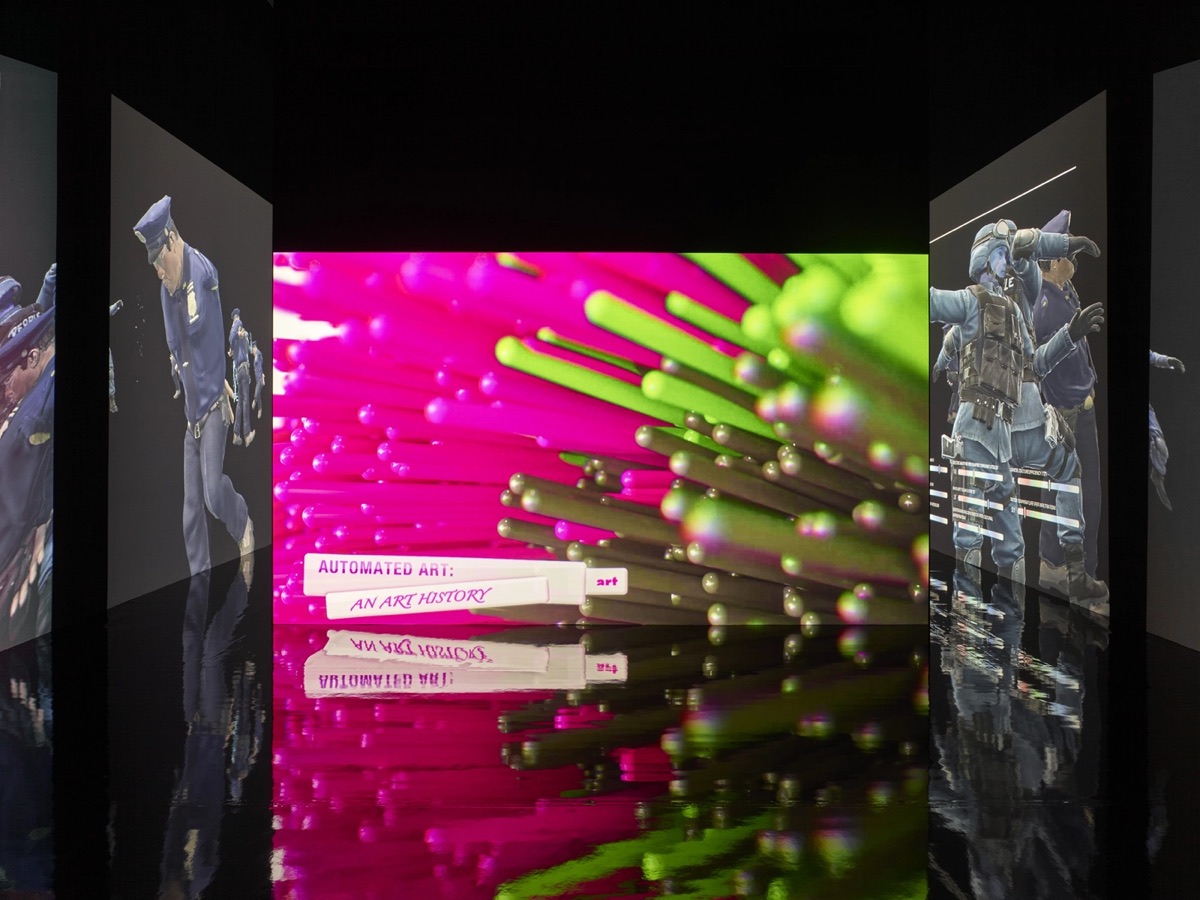
The show continues with Steyerl’s latest multimedia installation SocialSim (2020), which she partly produced during the pandemic lockdown. It critically explores the potential of digitality, simulation, and artificial intelligence and locates the visitors in the middle of an immersive VR space with dancing police and military men, projecting prognoses of energy consumption, riots, suicide rates, and rates of infection — a fierce comment on the social upheavals during the pandemic.
Dr Jana J Haeckel, 1854 / British Journal of Photography, 2021-07-01 · read the full text
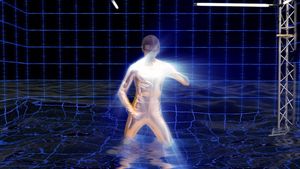
Eines der prominentesten Werke ist die eigens für die Ausstellung produzierte Arbeit SocialSim (2020), in der Schauspieler Mark Waschke als Kommissar in pandemiebedingter Kurzarbeit auftritt. Viele kennen ihn aus dem Berliner Tatort oder aus Steyerls Installation Factory of the Sun, die 2015 im deutschen Pavillon in Venedig ausgestellt wurde. Waschke befindet sich in einem Motion Capture Studio, in dem seine Bewegungen aufgezeichnet und in Daten übersetzt werden. Seine Tanzbewegungen dienen der Programmierung wuttanzender Polizistenavatare, die sich bald an allen Wänden des gänzlich von Leinwänden ummantelten Raums versammeln.
trans.One of the most prominent works is SocialSim (2020), produced specially for the exhibition, in which the actor Mark Waschke appears as a police inspector on pandemic-induced short-time work. Many will know him from the Berlin Tatort, or from Steyerl's installation Factory of the Sun, shown in the German Pavilion in Venice in 2015. Waschke is in a motion-capture studio, where his movements are recorded and translated into data. His dance movements serve to programme rage-dancing police avatars, which soon gather on every wall of the room, entirely sheathed in screens.Teresa Retzer, springerin 4/2020, 2020 · in German · read the full text
Credits
Single channel video, HD, 18 min. Blockbuster Cop: Mark Waschke. Hêja / Nefertiti: Hêja Netirk. Music: Kassem Mosse, Viola Klein featuring Whodat, Sabar by Abdou Aziz, Abdoukhadre and Adrame Diop (St. Louis), Bethany Barrett, variation on 'Rabbia e Tarantella' composed by Ennio Morricone performed by Bethany Barrett, Jules LaPlace and Liam Morrison, and others. 3D design and bouncing bubble politics: Maximilian Schmoetzer. Postproduction: Christoph Manz. Motion graphics: Magda Tuzinkiewicz. Lukas Loss — 360 photography. Zugang Kollektiv — additional footage (Berlin 29.08.2020: Can Kurucu, Tama Ruß, Ada Kopaz, Bruno Siegrist). Voice-over: Samantha Livingston. Simulations Dancing Mania / Rebellion — producer: Ayham Ghraowi; behaviour and effects programming: Robert Gerdisch; CG/real-time visualisations and 3D modeling: Lucas Gutierrez; additional programming: Baransel Tekin; neural snake charming: Jules Laplace. Covid-19 as Covid-19. Shot on location at .COM BAR. Outtakes: Broken Windows, Guards, Factory of the Sun, This is the Future. Excerpts from Ernst Lubitsch, Die Austernprinzessin (1919). Installation design: Manuel Reinartz, Emiliano Pistacchi, Maximilian Schmoetzer. Commissioned by Doris Krystof, K21 Düsseldorf, and Florian Ebner and Marcella Lista, Centre Pompidou Paris. Thanks to Tomás Saraceno, Rafael Matsunaga, Alice Conconi, Leah Turner, Emiliano Pistacchi, Andrew Kreps, Esther Schipper, Keijiro, Skinner FX, Miloš Trakilović, Giorgi Gago Gagoshidze, Tom Holert.