Hell Yeah We Fuck Die
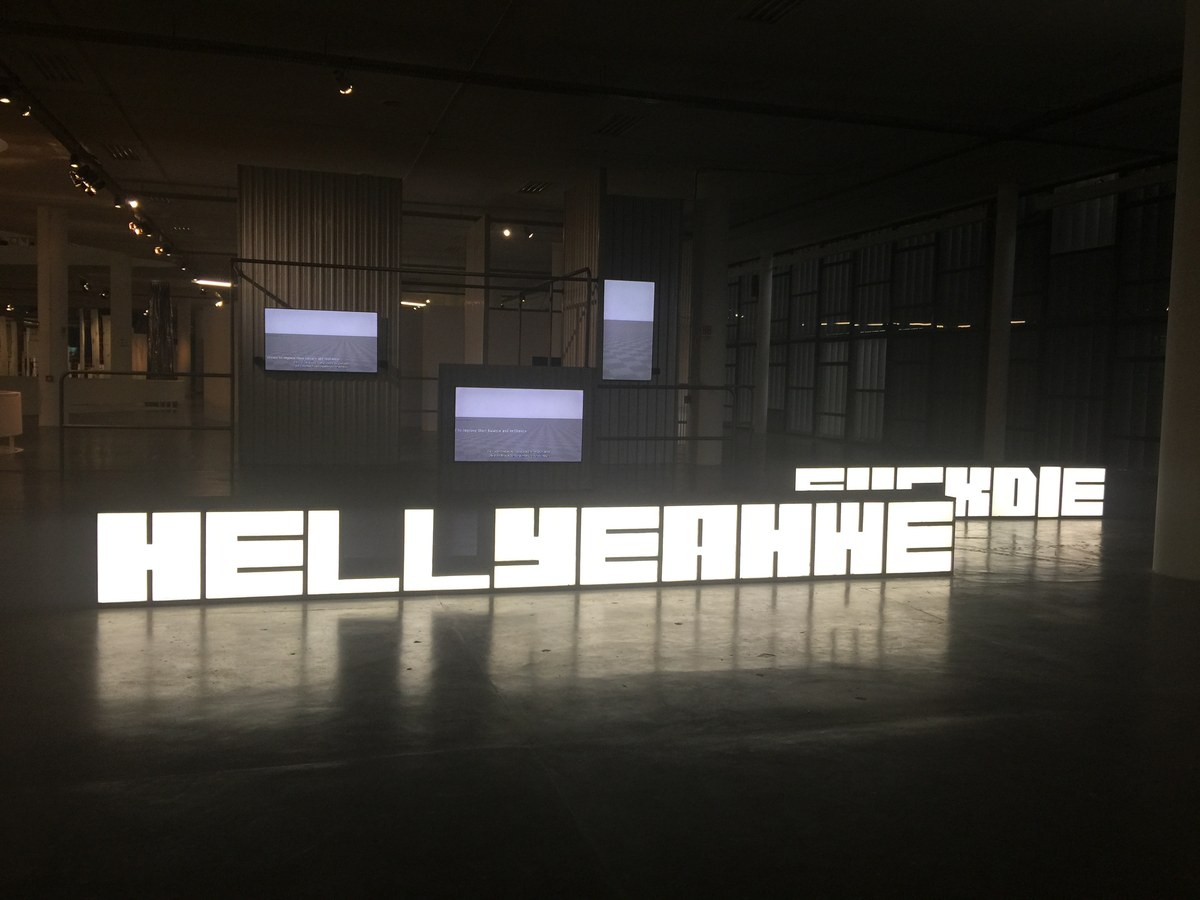
© Hito Steyerl
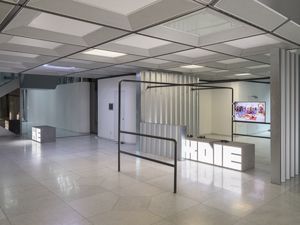
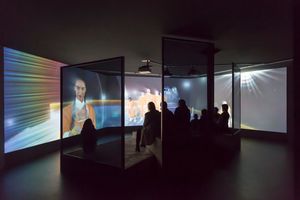
It is named for the five most common words in the English language pop charts of the 2010s. It features two video works. One, presented over three screens, homes in on robots used to save people in disaster zones. What we see, however, are scientists appearing to physically abuse their androids, in the name of training. The metallic backdrop becomes a sort of militarised athletics ground.
Joe Lloyd, Studio International, 2026-02-12 · read the full text
Drywall framing and aluminum sheeting divide the installation into two parts, each containing a short, looping video. The larger of the two sections features a hypercut of footage gathered from the internet of robot technology testing labs in which humanoid machines are subjected to physical abuse by their makers in the name of technological progress. The second video, Robots Today, shown on a single monitor in the smaller area of the installation, is set in Diyarbakır, the unofficial capital of Turkish or Northern Kurdistan. It recounts personal stories from the region as well as the story of Ismail al-Jazari, a twelfth-century engineer whose mechanical inventions presaged modern robotics.
Nando Alvarez-Perez, Cornelia Magazine, 2019-12-09 · read the full text
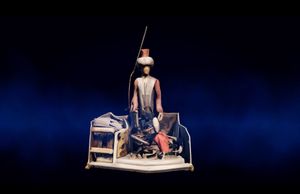
The ambitious exhibition begins with the installation Hell Yeah Fuck We Die (2016). Based on the five most common words used in English-language song titles from the previous decade (hell, yeah, we, fuck, and die), the display combines three video screens with robot sculptures, neon signs and hammering techno sound. The videos feature a compilation of images from robot technology testing labs collected from various online sources, in which humanoid robots are subject to abuse, both actual and simulated.
Dr Jana J Haeckel, 1854 / British Journal of Photography, 2021-07-01 · read the full text
Credits
3-channel video installation, environment, 2016; 4 min HD video. Original soundtrack by Kassem Mosse, based on research by David Taylor identifying the five most popular words in English song titles since 2010. Robot push-recovery, AI falling simulation and bipedal gait footage courtesy Thomas Geijtenbeek (goatstream.com), Michiel van de Panne, Frank van der Stappen, Natural Motion, MIT DARPA Robotics Team, Siyuan Feng (The Robotics Institute, Carnegie Mellon), Benjamin Stephens PhD (Carnegie Mellon), Zhibin (Alex) Li (University of Edinburgh), Noel Maalouf and Dr Imad Elhajj (Vision and Robotics Laboratory, American University of Beirut), Seedwell Media, ATRIAS robot video courtesy Oregon State University, and Terrestrial and Robotics Engineering Controls Laboratory, Virginia Tech. Postproduction: Christoph Manz, Maximilian Schmoetzer. Line producer: Lawren Joyce. Producer and director of photography, California Robotic Challenge: Kevan Jenson. Assistant: Miloš Trakilović. Thanks to Alice Conconi, Andrew Kreps, Gunnar Wendel, Esme Buden. Commissioned by the Fundação Bienal de São Paulo. Installation design: Manuel Reinartz.