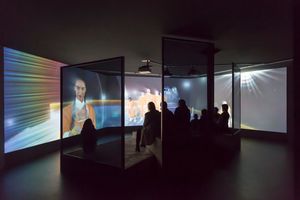
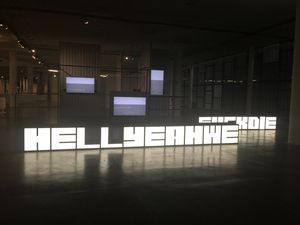
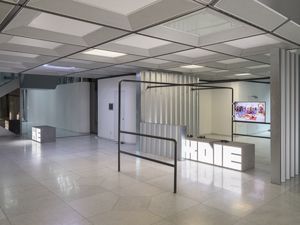
Mechanical Kurds
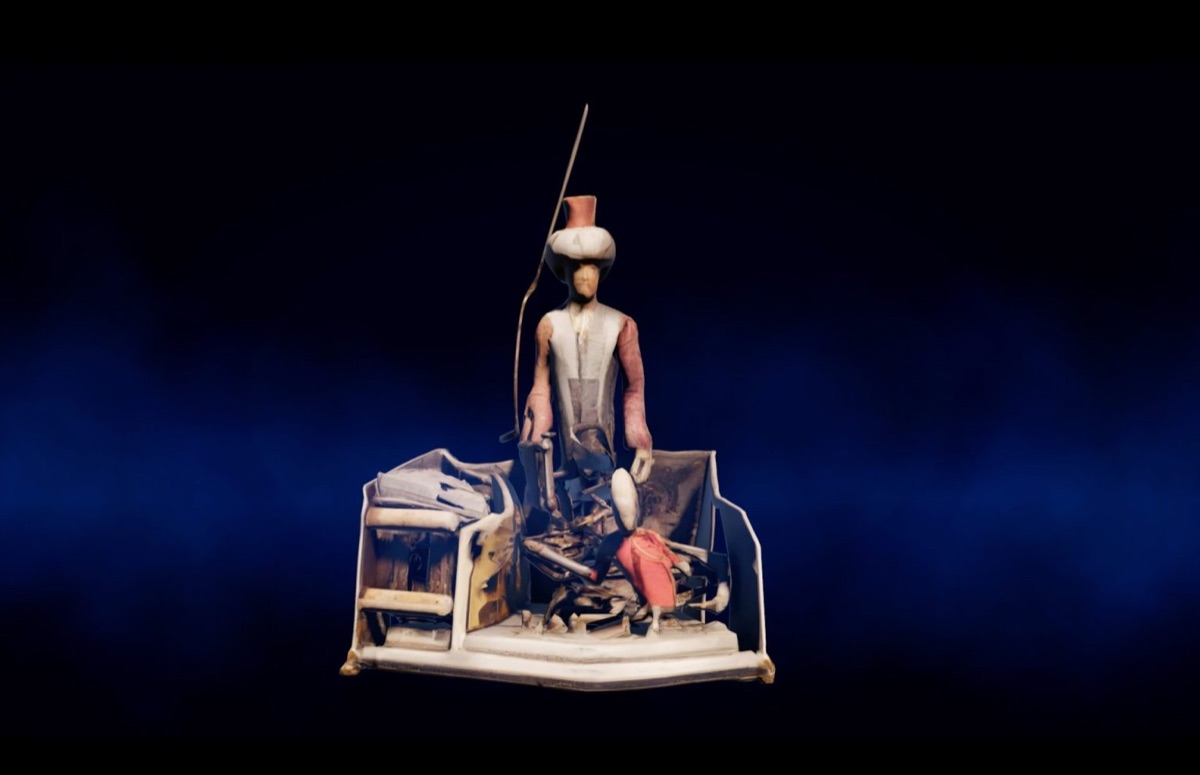
© Hito Steyerl
Über die Hintergründe des Auftrags - der die Bilderkennungssysteme der KI verbessern sollte - wurden sie im Unklaren gelassen. Als die KI die Aufgabe erledigen konnte, waren die Microworker Geschichte. Um diesen Prozess geht es in den rund ein Dutzend Gesprächen, die Steyerl mit solchen Datenarbeitern geführt hat, nachdem sie es geschafft hatte, 2023 eine Einreisegenehmigung für den Irak zu ergattern. (…) Steyerl findet mit rhythmisierter Musik und Hall unterlegte Bilder, die das Elend des Lagers mit einer von Drohnen kontrollierten Phantasiewelt samt den Feuerbällen explodierender Tuk-Tuks und jungen Männern kontrastiert, die um brennende Autos herumtanzen.
trans.They were left in the dark about the background of the commission — which was meant to improve the image-recognition systems of AI. Once the AI could do the job itself, the microworkers were history. That process is the subject of the roughly a dozen conversations Steyerl conducted with such data workers, after she had managed to obtain an entry permit for Iraq in 2023. (…) Steyerl finds images, underlaid with rhythmic music and reverb, that contrast the misery of the camp with a drone-controlled fantasy world, complete with the fireballs of exploding tuk-tuks and young men dancing around burning cars.Hannes Hintermeier, Frankfurter Allgemeine Zeitung, 2025-07 · in German · read the full text
The most notable exception is Hito Steyerl’s 2025 video installation Mechanical Kurds, a visually arresting commentary on human labor and AI warfare. In Steyerl’s single-screen video, we learn of Kurdish refugees in Northern Iraq training AI by image-tagging and labeling work that eventually benefits automated drone warfare. The people whose invisibilized labor trains these systems can themselves end up being made visible as the killing machines’ targets. Using AI to produce her AI-critical video, Steyerl’s work carries one of the exhibition’s main propositions: The critiqued tool can be utilized as a tool for critique.
Yazan Ashqar, Public Seminar, 2026-07-15 · read the full text
Hito Steyerl’s video installation Mechanical Kurds (2025) shows us Kurdish workers categorising objects in images that have been taken by drones; their classification then trains AI as part of Amazon’s ‘Mechanical Turk’ programme, which allows you to outsource menial tasks to overseas labour. Steyerl explicitly compares this painstaking work for poverty wages with its namesake: the 18th-century automaton that could apparently beat anyone in chess until it was revealed that a human was secretly operating it from the inside.
Zachary Ginsberg, Apollo Magazine, 2026-06-24 · read the full text
Poor Image gerra dîmenê derdixist pêş: dîmena ku tê kopîkirin, tê guvaştin, ji nû ve tê barkirin û di ser toran re tevdigere. Mechanical Kurds şert û mercên pêvajokirina dîmenê dîtbar dike. Dîmen tê xwendin, tê veqetandin, li objeyan û kategoriyan tê dabeşkirin, tê etîketkirin û di nav pergala daneyan de ji nû ve tê rêxistinkirin. Bi vî awayî dîmen ne tenê objeyeke ku digere ye; ew vediguherîne têketina pêvajoyeke din a hilberînê.
trans.Poor Image brought the image's circulation to the fore: the image that is copied, compressed, re-uploaded and travels across networks. Mechanical Kurds makes visible the conditions under which the image is processed. The image is read, separated out, divided into objects and categories, labelled, and reorganised within a data system. In this way the image is not merely an object in circulation; it becomes the input to another process of production.Mahsum Çiçek, FIREZZ, 2026-09-28 · read the full text
Credits
Single-screen video installation, colour, sound; 13:00 min. Courtesy the artist and Andrew Kreps, New York. Commissioned by the New Museum, New York and Jeu de Paume, Paris. Producers: Savaş Boyraz, Kovan Korki. Executive producers: Savaş Boyraz, Hêja Netirk. Camera and drone pilot: Xeîry Ertuşî. Music producer, singer and songwriter: Hêja Netirk. Music: Emrah Oğuztürk. Additional music: Saerom Park. Sound studio: PARRY AUDIO Studio & Mobile Recording (Karola Parry). Postproduction and 3D design: Christoph Manz, Vadim Schäffler. Unboxing: Hito Steyerl. Featuring Rebin Karim, M.H., W.O. and others. Acknowledgments: Alice Conconi, Adela Yawitz, Annabelle Liljegren, Andrew Kreps, Esther Schipper, Esme Buden, freesound.org. Installation design: Manuel Reinartz.