Power Plants
Interview · 3:54 · Serpentine
Pressing play loads the video from YouTube.
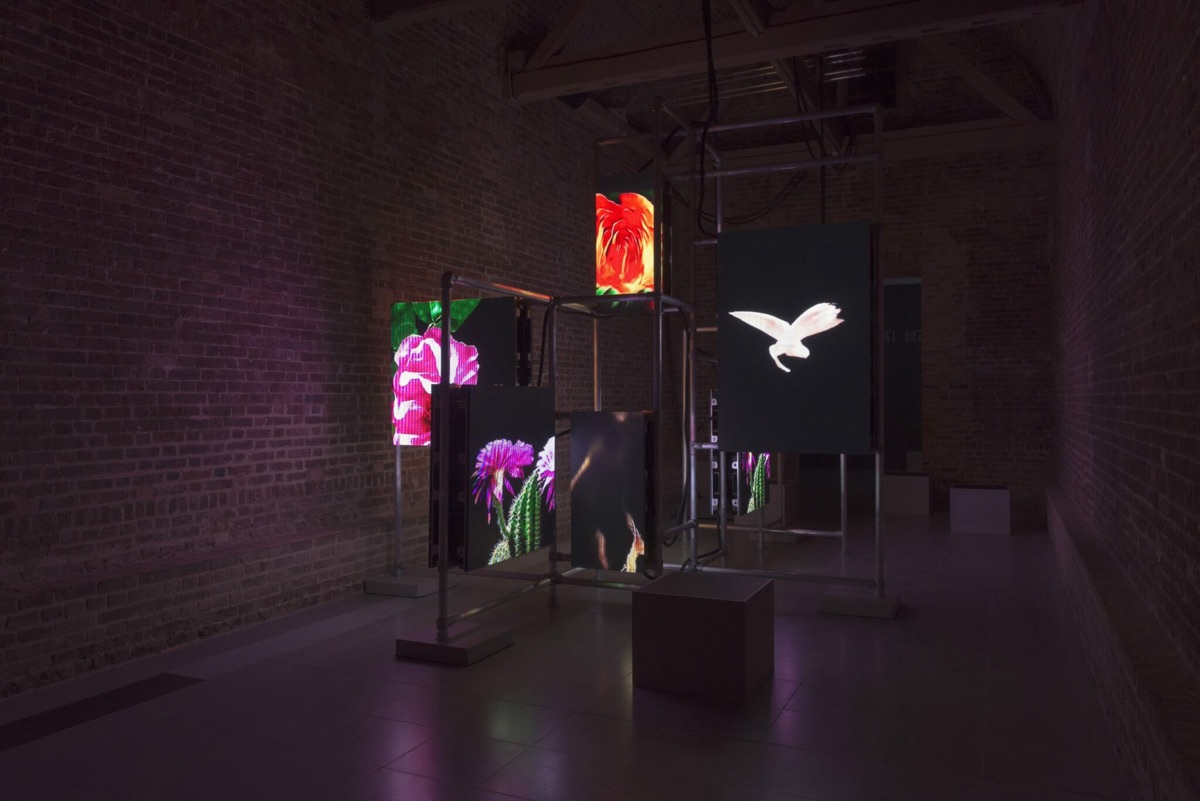
Steyerl’s exhibition examines the optics of power and immiseration, making the invisible visible. Also titled Power Plants, a series of videos on LED screens are mounted on a scaffold structure FIG.1. A few concrete blocks provide seating. The installation is inspired by ruderal plants, species that often grow by railways tracks, motorways, in the cracks between pavements or other disturbed and destroyed environments. Piercingly bright images of flora light the dark, windowless room, a sort of reverse photosynthesis, as if a future ecology has managed to adapt to climate collapse. The videos are generated by an artificial neural network, a form of artificial intelligence used in predictive analytics that is modelled on biological nervous systems. It amalgamates the previous seconds of video footage to produce new frames, which combine and recombine as visitors watch, forming blurry composite images.
Henry Broome, Burlington Contemporary, 2019-05-07 · read the full text
The whole gallery space is dark, filled with cryptic symbols, hovering technology and blooming nature. Somehow, Steyerl has combined all these disparate elements into a cohesive, beautiful whole. This is art that questions, exposes and attacks power structures. Steyerl uses technology to flay off the skin of an unjust society and uncover the corrupt flesh underneath. Above all, though, it looks incredible. Steyerl is swinging her art like a club, and you can feel every blow.
Eddy Frankel, Time Out London, 2019-04-10 · read the full text
Die Installation „Power Plants“ ist eingebettet in das größere Projekt „This is the Future“. In diesem auf eine LED-Leinwand projizierten Video begleitet man eine Erzählerin, die von einem geheimen Gefängnisgarten erzählt. Er ist angelegt von Gefangenen, stellt einen Versuch des symbolischen Ausbruchs dar und wird regelmäßig vom Wachpersonal zerstört. Also versucht die Erzählerin, den Garten in der Zukunft zu verstecken, generiert von Algorithmen. Dieser Garten ist „Power Plants“. So legt es jedenfalls die plötzlich transparent werdende Projektionsfläche von „This is the Future“ nahe, durch die der Blick auf die Acht-Monitor-Installation frei wird.
trans.The installation “Power Plants” is embedded in the larger project “This is the Future”. In that video, projected onto an LED screen, one follows a narrator who tells of a secret prison garden. Laid out by prisoners, it represents an attempt at a symbolic escape and is regularly destroyed by the guards. So the narrator tries to hide the garden in the future, generated by algorithms. That garden is “Power Plants”. At least this is what is suggested by the projection surface of “This is the Future”, which suddenly turns transparent, opening the view onto the eight-monitor installation behind it.Tom Mustroph, taz, 25 November 2019 · in German · read the full text
Credits
Installation: 14 single-channel videos, scaffolds, AR application, vinyl, seat elements, sound. Production: Serpentine Galleries. Initial prediction algorithm and technical advisory: Damien Henry. Neural video system: Jules Laplace. Music: Kojey Radical, Yokota Susumu. Sample RNN production: Damien Henry. Graphic design, typography, AR design and production: Ayham Ghraowi with Matt Wolff, Hrefna Sigurðardóttir and Ben Ganz. AR development and modeling: Ivaylo Getov, Caco Peguero. Camera: Savaş Boyraz, Takashi. Postproduction: Christoph Manz. Installation design support: Manuel Reinartz, Emiliano Pistacchi. Prediction: Hito Steyerl. Support: Vinyl Factory and Serpentine Galleries, Andrew Kreps and Esther Schipper. Project partners: Architects for Social Housing (Geraldine Dening, Simon Elmer); Disabled People Against Cuts (Ellen Clifford, John Kelly, Linda Burnip); Unite the Union Hotel Workers' Branch (Dave Turnbull); The Voice of Domestic Workers (Marissa Begonia, Mary Balquen); Reclaiming Our Futures Alliance; Constantine Gras, Piers Thompson. Technical team: Ayham Ghraowi, Ivaylo Getov, Caco Peguero, Matt Wolff, Robert Gerdisch, Max Schmoetzer. Music: Jules Laplace and Bethany Barrett. Kay Watson and Eva Jaeger commissioned and facilitated the AROS app; Amal Khalaf and Elizabeth Graham facilitated the partner conversations and coordinated the research and Power Tours. Thanks to Alice Conconi, Freya Murray, Anton Vidokle, Ben Vickers, Asakusa Osaka (Koichiro and Takashi), Miloš Trakilović, Gago Gagoshidze, Adnan Yildiz, Hanna Mattes, Leah Turner, Hans-Ulrich Obrist, Amira Gad, Holly Shuttleworth, Diego Duenas and Emily Wright. — Includes Actual Reality (Open Source): AR design and production Ayham Ghraowi with Matt Wolff, Hrefna Sigurðardóttir, Ben Ganz; AR development and modeling Ivaylo Getov, Caco; production Kay Watson, Serpentine Galleries; data set production Eva Jaeger; music Jules Laplace. — And Power Tours: four documentations of power walks and a tour through Hyde Park, video 8 min, colour, sound, with The Voice of Domestic Workers (Marissa Begonia, Mary Balquen and others), ASH (Geraldine Dening, Simon Elmer), DPAC (John Kelly) and Constantine Gras. Production: Amal Khalaf, Elizabeth Graham, Holly Shuttleworth, Serpentine Galleries. Sonification of economic inequality data: Bethany Barrett, Jules Laplace. Camera: Ben Pollard, Will Hazell. Sound: Ben Gandy. Assistant: David Dawson.