Abstract
© Hito Steyerl
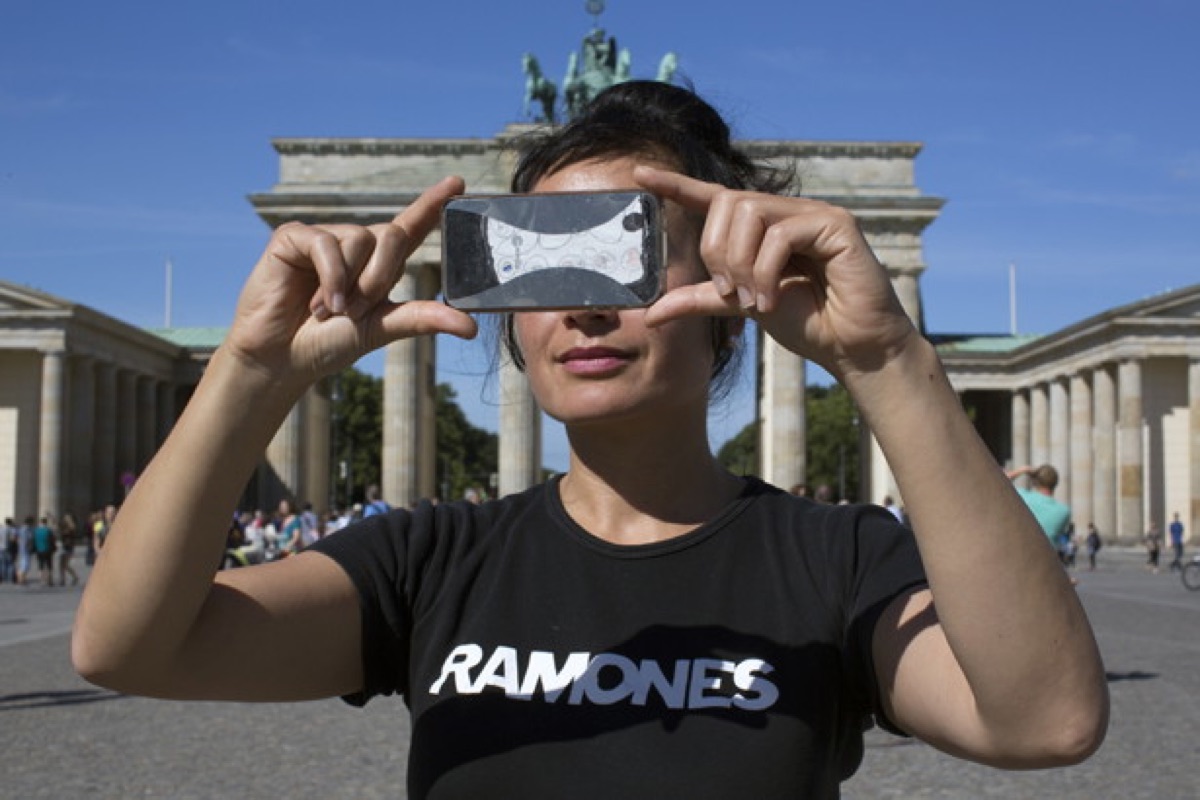
This seven-minute, two-channel video evokes the conceit of a core unit of cinematic “grammar” – shot-countershot – to enact a face-off between Berlin’s “empty centre”, around the Brandenburg Gate, and the site in Eastern Turkey of the alleged murder of Steyerl’s friend, Andrea Wolf, by the Turkish military in 1998. [2] On the one hand, the reverse function of the phone camera ostensibly aligns with the directional opposition of shot-countershot. At the same time, the orientation of the camera in three-dimensional space exercises a more expanded, free-floating mobility between – and beyond – the binary constraints of shot-countershot, portrait and landscape orientation, and frontal and lateral perspectives.
Lawrence Alexander, Frames Cinema Journal 18.1, 2021 · read the full text
Abstract (2012), too, invokes Wolf’s martyrdom. At e-flux, the video was projected onto two side-by-side screens. Often, footage on one screen is paired with a caption on the other. An image of a rough hillside appears next to the phrase “This is a shot.” Next, an image of Steyerl, in front of the Brandenburg Gate, holding an iPhone in front of her eyes as though taking a video, is coupled with the words “This is a countershot.”
Zoe Larkins, Art in America, 2012-11-29 · read the full text
Abstract includes footage from Steyerl’s visit to the mass grave where Wolf’s dead body was likely dumped and complements the forensic approach theorized in essays such as “A Thing like You and Me” and “Missing People.” In other words, here Steyerl starts to come closer to the internationalist project of Ivens and Loridan (and to move farther from Godard’s ironic distance): she journeys to the site of conflict instead of remaining in the metropole.
Michael Rothberg, The Implicated Subject (Stanford University Press), 2019 · read the full text
Credits
Double-channel HD video, 7 min, 2012. Camera: Tina Leisch, Selim Yildiz, Christoph Manz, Vincent Grunwald, Leon Kahane, Esme Buden, Diana McCarty. Sound: Apo. AD: Alwin Franke, Esme Buden. Postproduction: Christoph Manz. Translators: Neman Kara, Sahin Okay, Nejat Sunar. Thanks to Necati Sönmez, Şiyar, Ali Can, Oliver Rein, Eren Keskin, Bilgin Ayata, Hüsnü Yildiz, Diana McCarty. Produced by Instytut Sztuki Wyspa / Wyspa Institute of Art, Aneta Szylak.