November
Synopsis
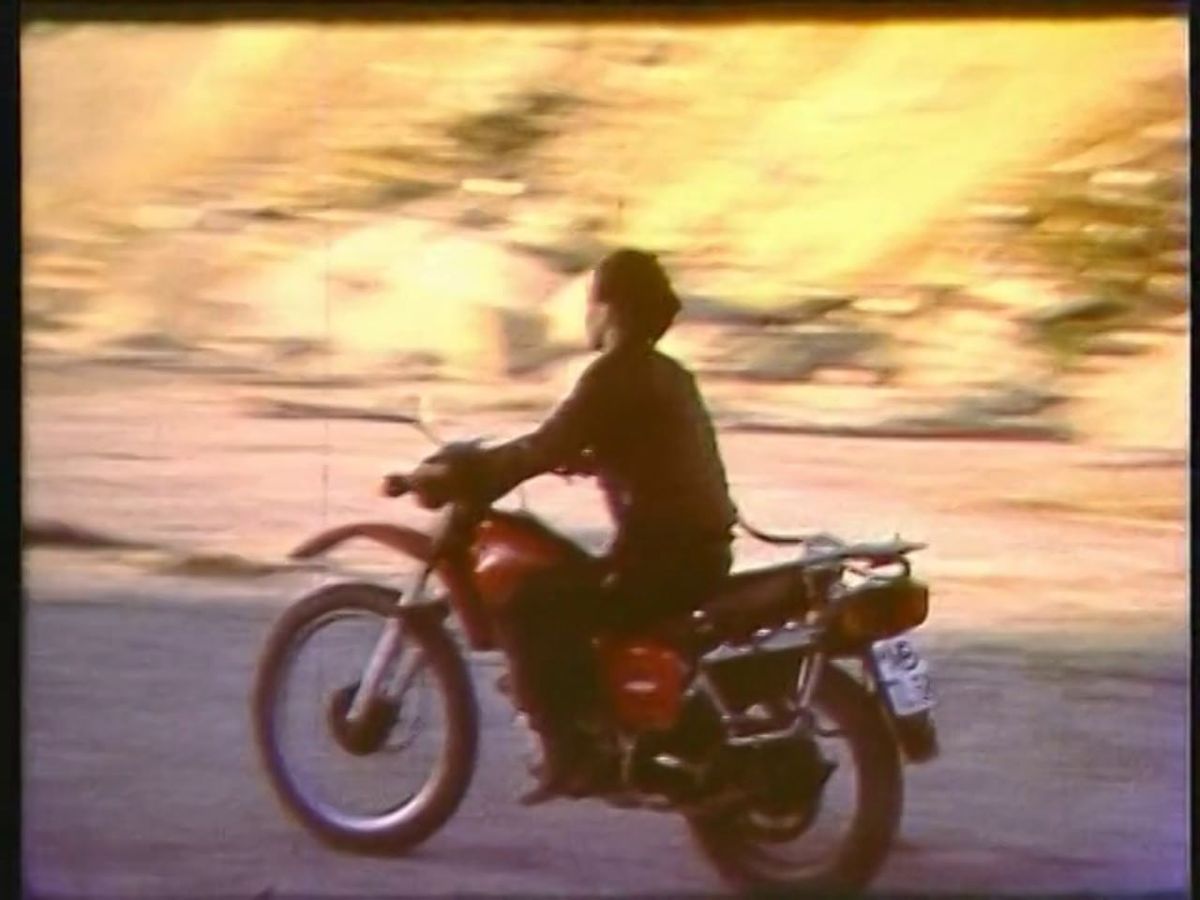
In the eighties Hito Steyerl shot a feminist martial arts film on Super-8 stock. Her best friend Andrea Wolf played the lead role, that of a woman warrior dressed in leather and mounted on a motorcycle. The engagement expressed in the formal grammar of exploitation films later became Wolf´s political praxis: She went to fight alongside the PKK in the Kurdish regions between Turkey and northern Iraq, where she was killed in 1998. Now honored by Kurds as an "immortal revolutionary," her portrait is carried at demonstrations. In november Hito Steyerl examines the spectrum of interrelationships between territorial power politics (as practiced by Turkey in Kurdistan with the support of Germany) and individual forms of resistance. Her memories and accounts of Wolf´s life provoke the filmmaker to engage in a fundamental reflexion: She comes to understand how fact and fiction are intertwined in the global discourse.

© Hito Steyerl
Full work · 25:14 · Kaleidoscope
November (2004), rodada en un principio como una película de Kung-Fu, se convirtió en el punto de partida de una búsqueda activa de respuestas. La cinta, protagonizada por ambas, es un compendio de luchas, en aras de la justicia, donde los «buenos», con sus manos desnudas, pelean contra los «villanos» que, significativamente, sí cuentan con armas. Como si de un presagio se tratase, la historia finaliza con una única superviviente que, dirigiéndose hacia el atardecer, se convierte en mito.
trans.November (2004), shot initially as a Kung-Fu film, became the starting point of an active search for answers. The film, starring the two of them, is a compendium of struggles in the cause of justice, in which the 'good' fight bare-handed against the 'villains' who, significantly, do have weapons. As if it were an omen, the story ends with a single survivor who, heading towards the sunset, becomes a myth.hoyesarte, hoyesarte.com, 2016-03-01 · in es · read the full text
The appropriated imagery of November takes us through a cinematic structure that would initially seem to oscillate between fictional and documentary material. This clear distinction is, however, complicated by each instance that makes us reconsider how gestures transgress the porous boundaries between the fictional and the factual. The film takes as its starting point sequences from a feminist martial arts film Hito Steyerl directed when she was 17 years old, with her friend Andrea Wolf starring as the charismatic combat heroine. The sequence is followed by a videotaped news interview of Andrea Wolf as a real-life Kurdish revolutionary fighter a few years later, before getting killed as a foreign revolutionary in 1998. The fiction film images of the leather-jacket-wearing female fighter thus oddly take on an almost prophetic quality in light of the later events, when Andrea morphs out of the screen to become a real guerrilla fighter in Kurdistan.
Pernille Lystlund Matzen, Interventions Journal, vol. 3 no. 3, 3 July 2014 · read the full text
In November’s structure, the reconstruction of the character is linked to the representational instability and proliferation of Wolf’s identities. Her two names, Andrea Wolf and Şehît Ronahî, already mark out this escalation, but while the name change was her choice, the full extent of the transformation of her image was not. In November, Andrea Wolf has many roles. She is an «attractive» woman, and a friend. She is a female fighter in a fictional story, who uses martial arts instead of weapons, and an armed revolutionary who also teaches martial arts to her fellow female fighters. A martyr for the Kurdish cause, allegedly executed by Turkish security forces, and a terrorist in hiding, according to the Turkish and German governments.
Vincenzo Estremo, Droste Effect, Bulletin 0, 2016 · read the full text
In the face of the fragmentation of life within the social and production relations of late capitalism, they can perhaps provide the ‘common language’ or ‘new form of literacy’ that Steyerl has claimed for as a political tool. Through the pivotal role of these popular images and sounds, her films have shown that is possible not only to offer a critical image of the world through the moving image (within or without an art context), but also to share strategies and tools for political struggle. This makes her films a new model of politicised filmmaking, one for which the term ‘populist’ – in reference to ‘the popular’ and not to ‘the people’ – is perhaps a compliment rather than a critique.
Pablo Lafuente, Afterall: A Journal of Art, Context and Enquiry 19, 64–70, Autumn 2008 · read the full text
Steyerl turns the critique of internationalism back on her own work and, in that sense, distinguishes her memorialization of Andrea Wolf from the affirmative commemoration of revolutionary martyrdom found among Wolf’s comrades. But the scene also stages the return of the subject, even if it is a subject caught—like Andrea before her—in a material web of traveling images. This surprising turn, in which the artist puts herself in the position of the Kurdish protestor whose trajectory we thought she was tracking, does not constitute the end of Steyerl’s Wolf project but something like its beginning. Since completing November in 2004, she has not abandoned the search for Andrea; instead, she has followed the story’s threads in ever more ambitious directions; in some ways, she has even become a “Kurdish protestor”!
Michael Rothberg, The Implicated Subject (Stanford University Press), 2019 · read the full text
Credits
Austria/Germany 2004, 25 min, DV. Director: Hito Steyerl. Editor: Stefan Landorf. Assistant: Yasmina Dekkar. Protagonist: Uli Maichle. Producer: Marta Kuzma, Manifesta 5. Supported by Klaus, Mehmet Aktas, Peter Grabher, Lisa Rosenblatt.